
GSOC Bonding - Understanding current coala's aspect code
coala's aspect project is still in its infancy, but a prototype already exists in the codebase. Diving into that code to analyse the core part about aspect.
This post is part of my GSOC journey in coala.
Even though aspect project in coala still in its infancy, there are already exist a basic prototype of itself in coala codebase. Today, I’ll dive into these code and try to analyze the core part about aspect.
Seek First to Understand, then to be Understood
That is a quote from the 7 habbit of Stephen Covey. It is a habbit for social interaction, but idk, I’ll try to make some connection here because I feel like it. It is important that I understand how the aspect code work first, and then iI could improve it with confidence and get some idea on how to code, the style, and the design flow.
Overview
As of today, commit efa6727,
coala have the the basic idea of what is an “aspect” is and a small aspect tree.
All of this code can be found in coalib.bearlib.aspects module. Beside this,
there also a small aspect code usage in coalib.bears class that used to bind
a aspect into Bear class. And also, according to coala strict 100% code
coverage, we have plenty of test to make sure the aspect code is healthy and
working.
Let’s start with the overviews of files under coalib.bearlib.aspects module.
__init.py__- “loaders” function to access all aspect class.base.py- parent class of aspect that define what an aspect ismeta.py- aspect metaclass that has function to relate between aspectstaste.py- define taste class, kinda like an “attribute” of a classcollections.py- special collection object for aspect (I WROTE THIS :D)docs.py- define documentation object (like metadata) that each aspect should haveroot.py,Metadata.py,Redundacy.py,Spelling.py- the definition of aspect
Glossary
Before going further, I will explain some of few keyterm used.
- aspect - the class itself
- aspectinstance - instance object of a taste. Always have a language.
- taste - a measurable properties that help define an aspect. A taste could have 1 or more language associated with it.
Languageclass - provide data structure for a (programming) language information.
Defining aspect in base.py
Next, let’s take a look first on how aspect defined inside base.py.
class aspectbase:

    def __init__(self, language, **taste_values):
        # bypass self.__setattr__
        self.__dict__['language'] = Language[language]
        for name, taste in type(self).tastes.items():
            if taste.languages and language not in taste.languages:
                if name in taste_values:
                    raise TasteError('%s.%s is not available for %s.' % (
                        type(self).__qualname__, name, language))
            else:
                setattr(self, name, taste_values.get(name, taste.default))

    def __eq__(self, other):
        return type(self) is type(other) and self.tastes == other.tastes

    @property
    def tastes(self):
        return {name: self.__dict__[name] for name in type(self).tastes
                if name in self.__dict__}

    def __setattr__(self, name, value):
        if name not in type(self).tastes:
            raise AttributeError(
                "can't set attributes of aspectclass instances")
        super().__setattr__(name, value)
Class aspectbase serve as the parent class of every aspect in coala. From
reading the __init__ method, we know that aspect has 2 type of “attribute”,
which is language and tastes. An aspect’s language attribute is a Language
object taken from coalang (coalib.bearlib.languages) modules.
After that, the taste attribute is initialized.
for name, taste in type(self).tastes.items():
    if ...:
        # skipped
    else:
        setattr(self, name, taste_values.get(name, taste.default))
First, in the else section, all the taste from an aspect definition will be initialized to the aspectinstance. If we define a custom value for a taste, that value will override the default one.
if taste.languages and language not in taste.languages:
    if name in taste_values:
        raise TasteError('%s.%s is not available for %s.' % (
            type(self).__qualname__, name, language))
The if part above is handling the case when an aspectinstance was initialized
with a custom taste value under the language that the taste itself doesn’t
support. In that case, the whole initialization will raise a TasteError
exception.
In short, we could instance an aspect like this:
>>> LineLength('Python')
<....Root.Formatting.LineLength object at 0x...>

>>> LineLength('Python').tastes
{'max_line_length': 80}

>>> LineLength('Python', max_line_length=100).tastes
{'max_line_length': 100}
Let’s move on to the next function, shall we.
def __eq__(self, other):
    return type(self) is type(other) and self.tastes == other.tastes
Overriding the === operator to compare the type object, make sure it has
the same metaclass aspectclass (more on this metaclass later), and have the
same tastes set.
@property
def tastes(self):
    return {name: self.__dict__[name] for name in type(self).tastes
        if name in self.__dict__}
Binding all taste into a single callable dict object for convience. So the
LineLength('Python').tastes will be possible. The @property decorator make
the tastes attribute kind of a readonly attribute of an aspect class.
def __setattr__(self, name, value):
if name not in type(self).tastes:
    raise AttributeError(
        "can't set attributes of aspectclass instances")
super().__setattr__(name, value)
Block any attempt to add another taste object into this after instatiation. The tastes list is kind of immutable.
Inter aspect relation in meta.py
Aspect is structured like a tree. Last month, I wrote a small script that traverse these tree and generate the tree diagram.
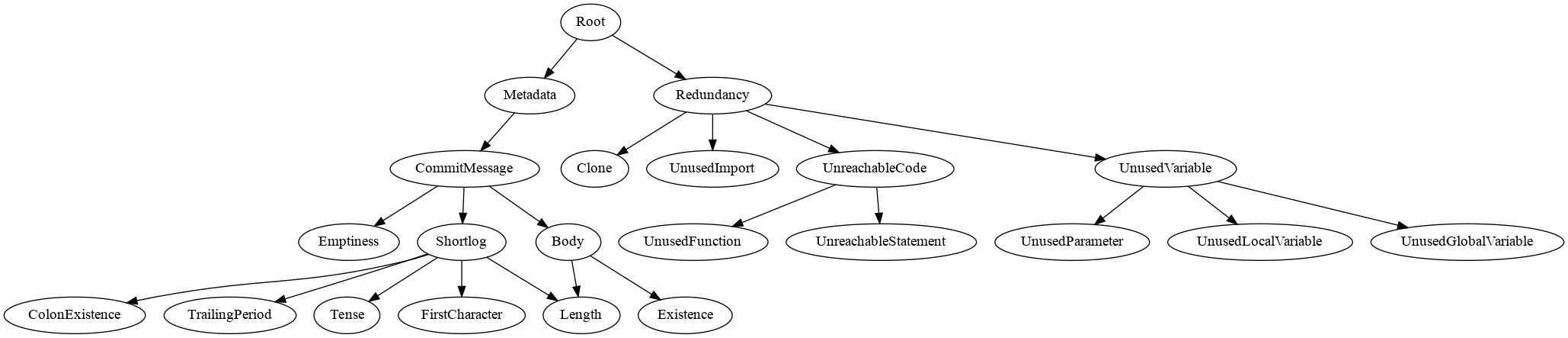
The meta.py hold the metaclass declaration that responsible to link a parent
aspect and it’s children aspect, recursively. Also, this metaclass hold a clever
function/decorator to automatically handle this linking process when declaring
the children aspect. Let’s take a look at the code.
class aspectclass(type):
    def __init__(cls, clsname, bases, clsattrs):
        """
        Initializes the ``.subaspects`` dict on new aspectclasses.
        """
        cls.subaspects = {}
Each aspect should have dictionary called subaspects that hold its children.
    @property
    def tastes(cls):
        """
        Get a dictionary of all taste names mapped to their
        :class:`coalib.bearlib.aspects.Taste` instances.
        """
        if cls.parent:
            return dict(cls.parent.tastes, **cls._tastes)

        return dict(cls._tastes)
Define a property to access tastes. The cls._tastes attribute was defined
manually in the Root aspect as an empty dict. Later, the children aspect will
fill their _tastes with their own tastes and the parent’s tastes. More on this
later. Note that the tastes function on aspectbase was actually refering to
this function for the implementation detail. This was the actual method used
when we call LineLength('Python').tastes.
    def subaspect(cls, subcls):
        """
        The sub-aspectclass decorator.

        See :class:`coalib.bearlib.aspects.Root` for description
        and usage.
        """
        aspectname = subcls.__name__

        docs = getattr(subcls, 'docs', None)
        aspectdocs = Documentation(subcls.__doc__, **{
            attr: getattr(docs, attr, '') for attr in
            list(signature(Documentation).parameters.keys())[1:]})

        # search for tastes in the sub-aspectclass
        subtastes = {}
        for name, member in getmembers(subcls):
            if isinstance(member, Taste):
                # tell the taste its own name
                member.name = name
                subtastes[name] = member

        class Sub(subcls, aspectbase, metaclass=aspectclass):
            __module__ = subcls.__module__

            parent = cls

            docs = aspectdocs
            _tastes = subtastes

        members = sorted(Sub.tastes)
        if members:
            Sub = generate_repr(*members)(Sub)

        Sub.__name__ = aspectname
        Sub.__qualname__ = '%s.%s' % (cls.__qualname__, aspectname)
        cls.subaspects[aspectname] = Sub
        setattr(cls, aspectname, Sub)
        return Sub
This not-so-simple subaspect method is the decorator used to declare and link
a children aspect to its parent. I will describe this method part by part.
aspectname = subcls.__name__
Save the children aspect name for further reference.
docs = getattr(subcls, 'docs', None)
aspectdocs = Documentation(subcls.__doc__, **{
    attr: getattr(docs, attr, '') for attr in
    list(signature(Documentation).parameters.keys())[1:]})
Setup the Documentation object of the aspect children.
subtastes = {}
for name, member in getmembers(subcls):
    if isinstance(member, Taste):
        # tell the taste its own name
        member.name = name
        subtastes[name] = member
Search and collect every Taste object that declared on the aspect children
class and append it to subtastes dict.
class Sub(subcls, aspectbase, metaclass=aspectclass):
    __module__ = subcls.__module__

    parent = cls

    docs = aspectdocs
    _tastes = subtastes
Declaring class to serve as “prototype” object that will override the aspect children class.
members = sorted(Sub.tastes)
if members:
    Sub = generate_repr(*members)(Sub)
Just auto generating the tastes string representation.
Sub.__name__ = aspectname
Sub.__qualname__ = '%s.%s' % (cls.__qualname__, aspectname)
Declaring children aspect shortname as __name__ and its fully qualified name
that contain its parent name too as __qualname__.
cls.subaspects[aspectname] = Sub
Reference back the children aspect on its parent aspect.
return Sub
Return the modified class. So this function could be used as decorator for a class.
Summary
The aspect in coala was defined on 2 part, its base class aspectbase serve
as the foundation that define its basic characteristic and how we can declare
a basic aspect. Next we have the metaclass aspectclass that responsible for
parent-children relationship of an aspect and provide utility function to
declare new child aspect.